“A serious and good philosophical work could be written consisting entirely of jokes.”
Ludwig Wittgenstein(words attributed to him, as reported by Norman Malcolm)1
A twin volume to Tractatus Theta
(tractatus.piotrzientara.pl): the same
decimal Wittgensteinian syntax2 (1, 1.1, 1.11 …), but here the elementary sentence is
a joke, not a proposition. Each main number is one joke; the decimals are
its analysis. Theta turned upside down: a parody of its own treatise that brings
a new perspective. You do not need to know Tractatus Theta to read Ludens; it is enough to know that this is its mirror image, its playful reflection.
Download
The whole book for offline reading:PDFEPUBBilingual edition (PL + EN):PDFEPUB
EPUB opens on Kindle (Send to Kindle) and any e-reader.
Preface
Each of these jokes is a person who thought they stood on the top floor. The one with
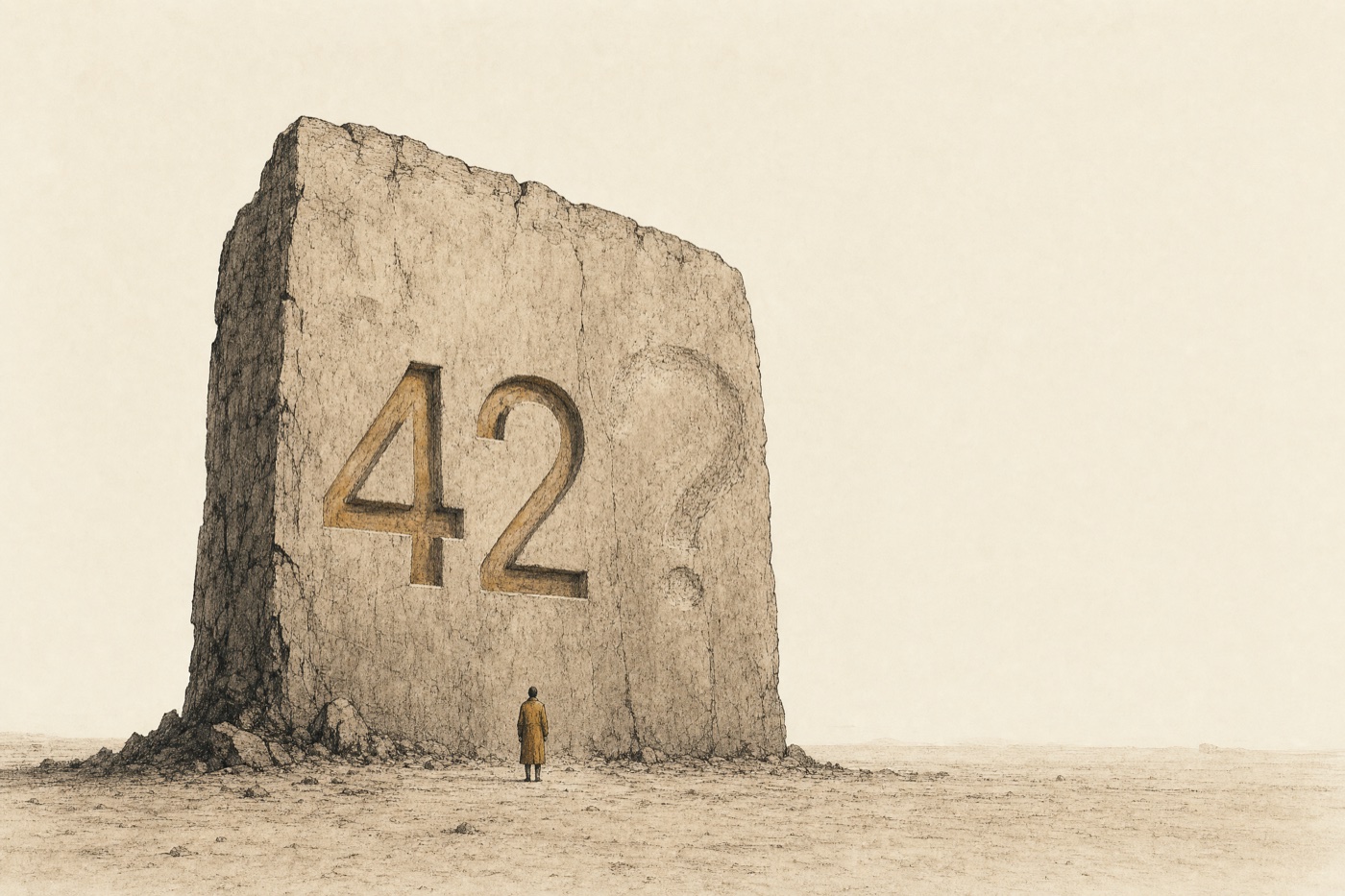
the answer to everything was sure that 42 was the end, and did not know the question.
The tyrant, that he held everything. The programmer, that he was the last interpreter.
And the one who would not cross on the light, that the flashlight would surely go out.
A joke is what happens when the floor you took for the last one opens beneath you and
turns out to have one more below.
The difference between an optimist and a pessimist is best caught by Danis
Tanović's No Man's Land3: the pessimist says “it can't get any worse”; the
optimist, cheerfully, “oh yes it can!” Optimism is not the belief that things are good,
but the certainty that under every last floor one more is waiting.
Philosophy and the joke make exactly the same move: both pull the floor out from under
you. They differ only in what lies beneath. Philosophy leaves you in mid-air. The
Tractatus ends in silence (7), because above the top floor there are no more
words. The joke, in that same half-second of falling, hands you a beam of light and lets
you land: laughter. That is why one can write a serious philosophical work consisting
entirely of jokes. It does all the work of philosophy (it removes every floor), but it
catches you every time.
That is the whole difference between Theta and Ludens. Theta
climbs the ladder upward and, as Wittgenstein requires (6.54), throws it away at the end,
remaining in silence. Ludens climbs down the same ladder, all the way to the
simplest joke in the world. It goes like this:
A Philosopher, a Tyrant and a Programmer walk into a bar. The wizard behind the
counter bows: “Good day, Mr Piotr. Three beers?”
If Lem4 asked how chance co-authors literature and culture, this treatise asks how chance co-authors the joke, the smallest form in which meaning betrays that it is not fully obedient to intention.
1. The meaning of life, the universe and everything really is 42.
Deep Thought, a computer the size of a planet, calculated for seven and a half million years. The answer is: 42. (Douglas Adams, The Hitchhiker's Guide to the Galaxy5; the scene on YouTube.)
And it is the correct answer, because it really is about everything. 42 in ASCII is the character *, and * is the wildcard: the pattern that matches everything. The question asked for the meaning of life, the universe and everything; the answer, decoded, is literally the sign for “everything”.
The same byte is at once the number 42, the character *, and the word “everything”. Which of them it is, the interpreter decides (see Joke three). The meaning is not in the number; it is in the reading.
That is why 42 closes the set. * is the only pattern that contains the whole set at once; whoever holds the wildcard holds the sum of everything. The answer to everything is not one thing in the world, but the sign for all things at once.
The trouble is that we have the answer and not the question. Adams knew it: once you are given “everything”, there remains the question of what you actually wanted. The answer to everything does not tell you what to ask.
The universe's most serious answer is a joke: a planet-sized computer, seven million years, and a number that explains nothing yet closes everything. That is exactly what this volume is about (see the epigraph): a meaning that is true precisely because it is a joke.
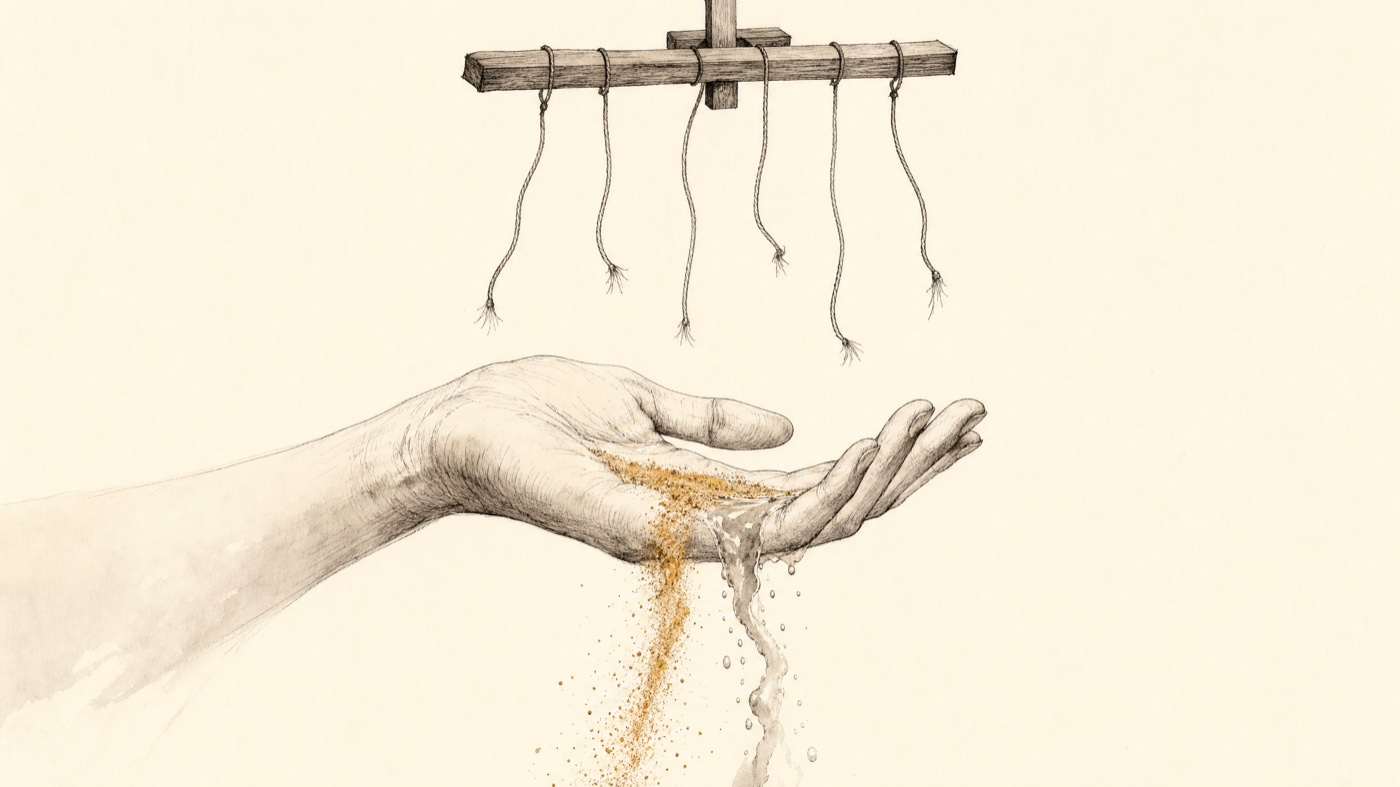
2. Whoever thinks they hold full power, understood as control, has just lost it.
The proof is one line. Full control would have to include control over the thought “I have full control”. But that thought came to you on its own, unbidden. There is therefore at least one event beyond your power: your own belief in your power. The set is not closed.
In the first joke the wildcard closed the set (1.4): * matches everything. Here the man of power only thinks he has closed it. The whole difference between having and illusion lies in that one “thinks that”.
Control, like health, is invisible. You feel only the organ that begins to fail. The sentence “I have full power” is a symptom, the first ache of an organ whose existence was unknown while it worked.
The word “power” carries two senses at once: mastery over oneself, and the power of the state. The same sentence thus reads twice, privately and politically, and is true in both registers. The evening on which a regime feels it holds everything is always the evening before. (The night before the Wall. The Stasi at the peak of its files.)
The amateur feels in command, because for him command is still an event, an achievement. The master feels nothing: control has dissolved into the act. Hence the law: the feeling of control is inversely proportional to mastery. Whoever feels it most strongly commands least.
You do not hold power; power holds you. The throne stands on the king, not the king on the throne. Whoever grips hardest is gripped hardest by what he grips.6
And yet the king sits on the throne not so that all may see him, but so that he may see all. The throne is a watchtower, not a stage; elevation serves sight, not splendour. And here the second joke shakes hands with the third: whoever sees everyone is an interpreter one floor up (3.33), and so holds power, that is, knowledge.
Sentence 2 is therefore self-refuting: it can be uttered only from a place where it is no longer true. Fullness is silent. Whoever has reached this line must throw it away like a ladder and go on ruling without knowing that they rule. (cf. 6.54)
There remains the inverse question: is there a power that does not know it is a power, and is that still power, or already grace?
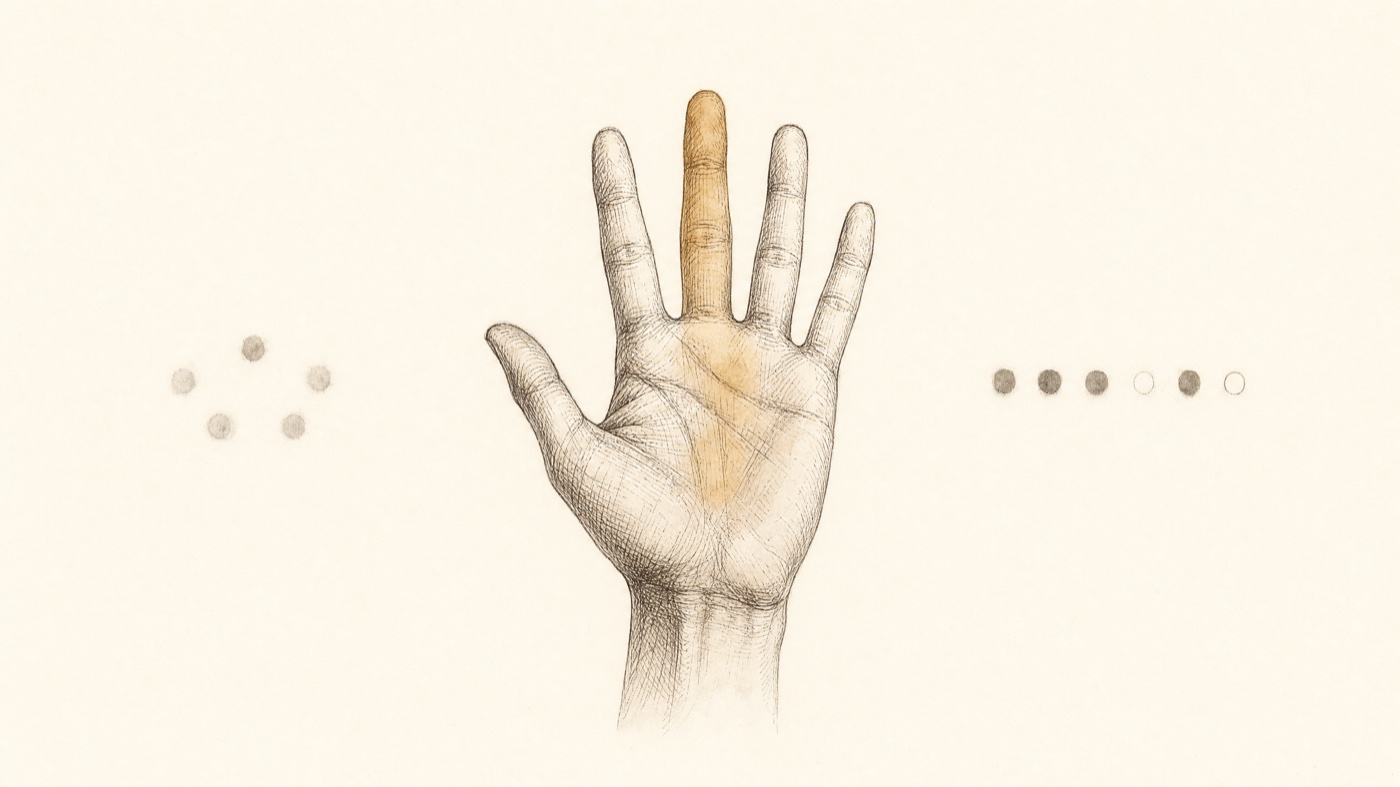
3. On the fingers of one hand you count to five or to thirty-one, depending on who is reading. The force lies not in the hand but in the interpretation.
(Where counting to thirty-one on one hand comes from: I explain it in my talk.)
Five fingers in unary notation (tally marks) are the numbers 0–5. The same five fingers as bits are 0–31. The hand did not change; the reading did. A sixfold increase of meaning without one new gram of matter. (Unary treats five different fingers as five copies of the same. Binary respects that each finger is itself.)
The sign is what is seen; the symbol is what the sign means in use (Wittgenstein 3.32). Two raised fingers are the same sign, while “2” and “00010” are two different symbols. The power belongs to the method of projection (3.11), not to the finger.
In the same binary notation from 3.1, four is 00100: the middle finger alone. Whether someone sees a “4” on the hand or the message to get lost is therefore a matter of interpretation. The same sign, two symbols (3.11); only the reader who chose the second reading takes offence, and that choice can be declined. There is no longer any need to take offence.
Hence the programmer's rule: data have no meaning until something interprets them. The byte 42 is the number forty-two, the character * in ASCII, or the wildcard that matches everything, depending on whose interpreter reads it. The byte is innocent. The power belongs to the runtime.
And that is why 42 is the correct answer to the question of the meaning of everything (Joke one): read as *, it is simply the sign for “everything”. It really is about everything. (the Adams scene.)
That is why a fool can be interpreted as wise: a kinder interpreter is enough. Interpretation is an act of grace or an act of power, and it is never clear which. (This is the missing answer to 2.7.)
Here the regress enters. You do not know whether the kind interpretation came from you, or whether the fool is so camouflaged that he foresaw your interpretation and produced a perfect interpretation of your interpretation. The first testifies to your wisdom, the second to his. From inside the system there is no way to decide which floor you stand on.
This resembles the halting problem disguised as a person: there is no procedure that, from observation alone, will decide whether he halts on wisdom or is playing. From the outside, no nontrivial property of a soul can be decided.
Whoever is one floor up interprets; whoever is interpreted is data. But every interpreter is someone's data. The stack has neither bottom nor top; it has only the floor currently in command.
Hence Bacon's famous dictum, scientia potestas est7: knowledge is power, because knowledge is simply possession of the interpreter, and power (Joke two) is being one floor above what you read. To know is to read; to be read is to be subject. The same relation, two names.
The trilogy closes. The first jokeclosed the set (*, the sign for everything). The second opened it (control that cannot be closed). The third says why it cannot: because above every set waits an interpreter one floor up, and that floor cannot be shut. The Philosopher, the tyrant and the programmer are three men who thought they stood on the top floor.
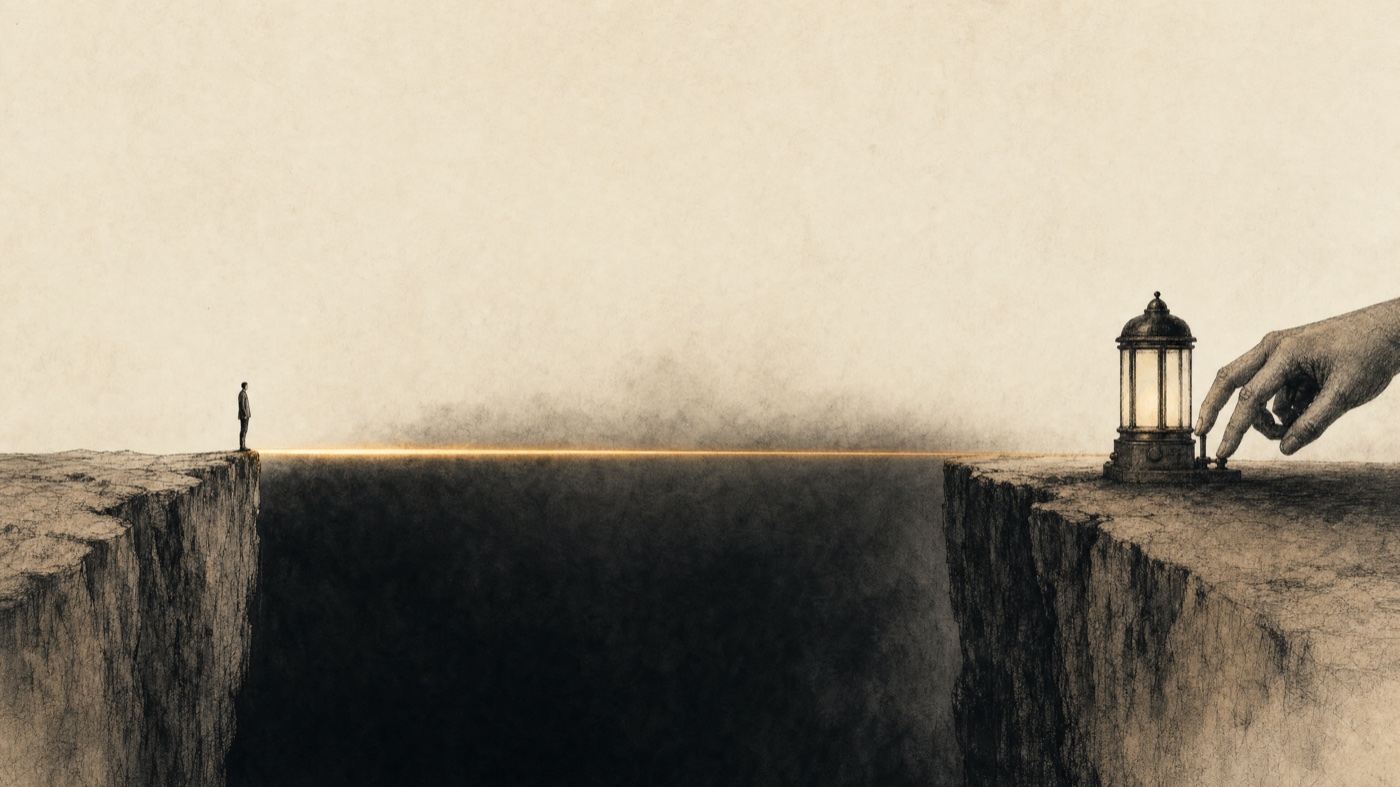
4. Trust is a beam of light: it carries you only as long as no one on the other side switches off the flashlight. There is no way to test it, because to test it is already to fall.
(A long joke, the Joker's most famous, from Alan Moore's The Killing Joke8.)
After a long chase Batman finally corners the Joker. He does not strike him. He reaches
out a hand and says: it does not have to end the way it always does; help me master the
chaos in Gotham, together we could rule it. The Joker looks at the outstretched hand and,
instead of slapping it away or taking it, answers with another joke:
Two madmen escape from an asylum at night across the rooftops. The first leaps
the narrow gap with ease; the second stops, afraid he will fall. The first offers to
shine a flashlight across the gap so the other can walk over on the beam. The second
refuses: the light would only go out when he was halfway across.
And both of them laugh. And the worst part is that Batman laughs too.
The beam of light is a bridge with no material. A wooden plank holds regardless of whether the builder still loves you. The beam of light holds only as long as another's hand holds it. Trust is not a bridge, but a promise pretending to be one.
That is why it cannot be tested. To ask “won't it go out?” is to stand beside it, not to step on. Whoever tries the light with a foot has already fallen. (Wittgenstein, On Certainty9: there are hinge propositions one must stand on precisely because one must not open them.)
And here the inversion. For the sane, refusing rescue is madness; for the madman, trusting the light is madness. Both sit in the same asylum, and from outside there is no telling which is the lunatic and which the only sober one (see 3.31). Maybe the second is no coward; maybe he alone noticed that the light has no bottom.
The flashlight is held by whoever has the power (Joke two): at any moment he can switch it off. To cross on the light means to hand your own switch to another, to agree to be data in someone else's runtime (3.2), to accept that someone else is one floor up (2.51, 3.33).
The inverse function of betrayal is trust, but a function that cannot be guaranteed, because its only carrier is another's will. The second madman will not take that risk: since the light can go out halfway, he steps on no beam. He stays on his roof, alone, safe, on the wrong side of the gap.
Why does the Joker answer Batman with a joke and not a hand? Because a joke is the only beam of light both madmen will step on at once. Laughter takes nothing back; it cannot be switched off halfway, because it lasts exactly as long as the crossing. Batman held out a plank the Joker does not trust, so the Joker threw a beam between them that both crossed. They did not trust each other. But they laughed together and for a second met in the middle of the gap.
Every joke is such a crossing: the teller throws a beam (the setup), and you walk along it not knowing whether the punchline will bear your weight. Laughter is the foot that landed on the far roof. That is why to get a joke is to trust, and why you cannot laugh on command, just as you cannot trust on command.
Hence the epigraph at the start of the volume. “A serious and good philosophical work could be written consisting entirely of jokes”: because a joke is the only bridge between two minds that neither can switch off on the other. This treatise does not speak about trust in jokes; it is a proof by construction. Here are the beams of light one has just crossed, without once asking whether they would go out. (Even this treatise thought it ended at 3.41: it too stood on a floor it took for the last.)
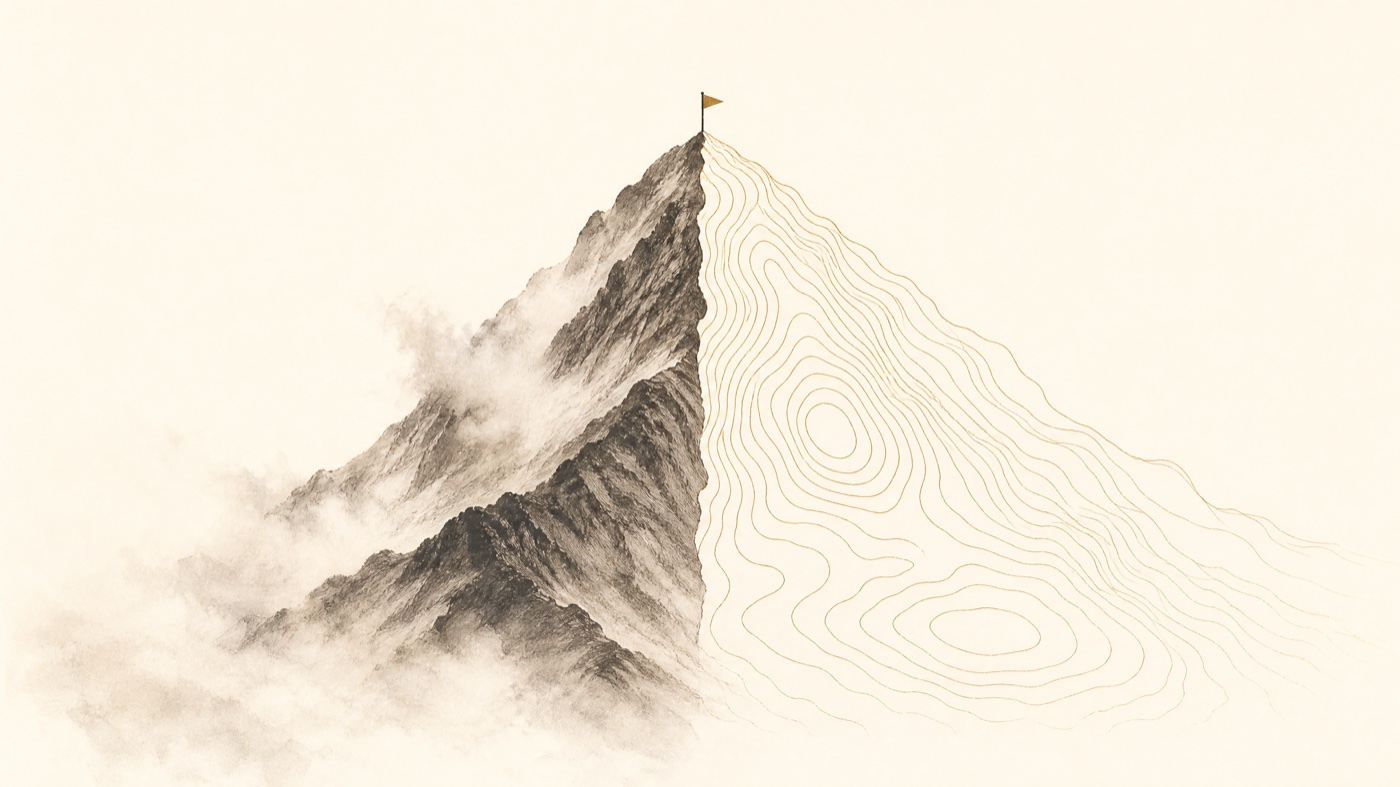
5. Before Mount Everest was discovered, what was the tallest mountain in the world?
(A joke contributed by codesota.com, with thanks.)
The answer: Mount Everest. It was the tallest even when no one knew it. The discovery happened on the map, not in the terrain; the mountain did not grow on the day it was measured. The question is a trap of perception: it suggests that “to discover” means “to make”, and makes us confuse an event in knowledge with an event in the world. (Korzybski10: the map is not the territory.)
Every model is wrong, some are useful (Box11). The same as map and territory in 5.1, only from the side of use: a model does not stop being false by working. And is the pattern “all models are wrong” also wrong? If so, then some are right, and we are back at proposition 2, which can be uttered only from where it is no longer true.
This is a necessary correction to the third joke. There, “the force lies in interpretation”, and that is true, but only over the map. The same hand could be read as 5 or 31; no reading will make Everest lower. Interpretation is the ruler of meaning and has not a gram of power over the mountain. The map changes with the reading; the terrain does not.
It was named after George Everest, a British surveyor, as if to measure were to create. This is the illusion of control from the second joke in its cartographic version: the tyrant of the map believes the terrain begins to exist the moment he draws it in.
The opposite mistake belongs to the fairy-tale prince Alexander. He had the best teacher in the world, Aristotle, and even he could not answer where the prince got the golden screw in his navel. Three expeditions and the death of many subjects later, it turns out that the only road to the answer runs through digging a great pit (and a borehole) on the tallest mountain in the world. (What the screw is for, we keep silent; rule seven.) Where the sage of 5.1 sees that the mountain was tallest before it was measured, there affluence orders the mountain dug up, just to find out a thing better left unknown. It is a mockery of perseverance that never asks whether the goal is worth it: of pursuing a goal at any cost, and of a wealth that breeds undertakings barren and most laborious. The tallest mountain in the world is sometimes a truth one need not conquer (5.1), and sometimes a pit one must dig for nothing.
But the same mountain has another side. The sage of 5.1 and the prince of 5.31 make one and the same gesture, in reverse: the first leaves the summit untouched, the second digs it up. The perseverance this volume mocks is not all perseverance, only the kind that never asks whether the goal is worth it. Whoever asked and set down the screwdriver did not lose the climb. He refused to dig a pit for what he already is.
To give up in time is the only move that does not unscrew the screw. And the screw, recall from 2.5, holds the seat: the throne stands on the king, not the king on the throne. Whoever keeps turning to the very end unseats himself.
So the one who left in time is not the second madman of 4.2, who would not step onto the light. He is the Alexander of the seventh joke: he did not stop playing, he stopped drowning the rest out. He found, so he fell silent, and only now can you hear that the rest sounds on its own.
And here the earlier jokes return. The second madman of the fourth joke was right about one thing: the beam of light is a map laid over the void, not terrain, which is why he did not cross. And the 42 of the first joke is an answer without a question, that is, a map without terrain: the sign for “everything”, under which it is unknown what actually lies. To gain the answer is not yet to gain the meaning; meaning is terrain, not map.
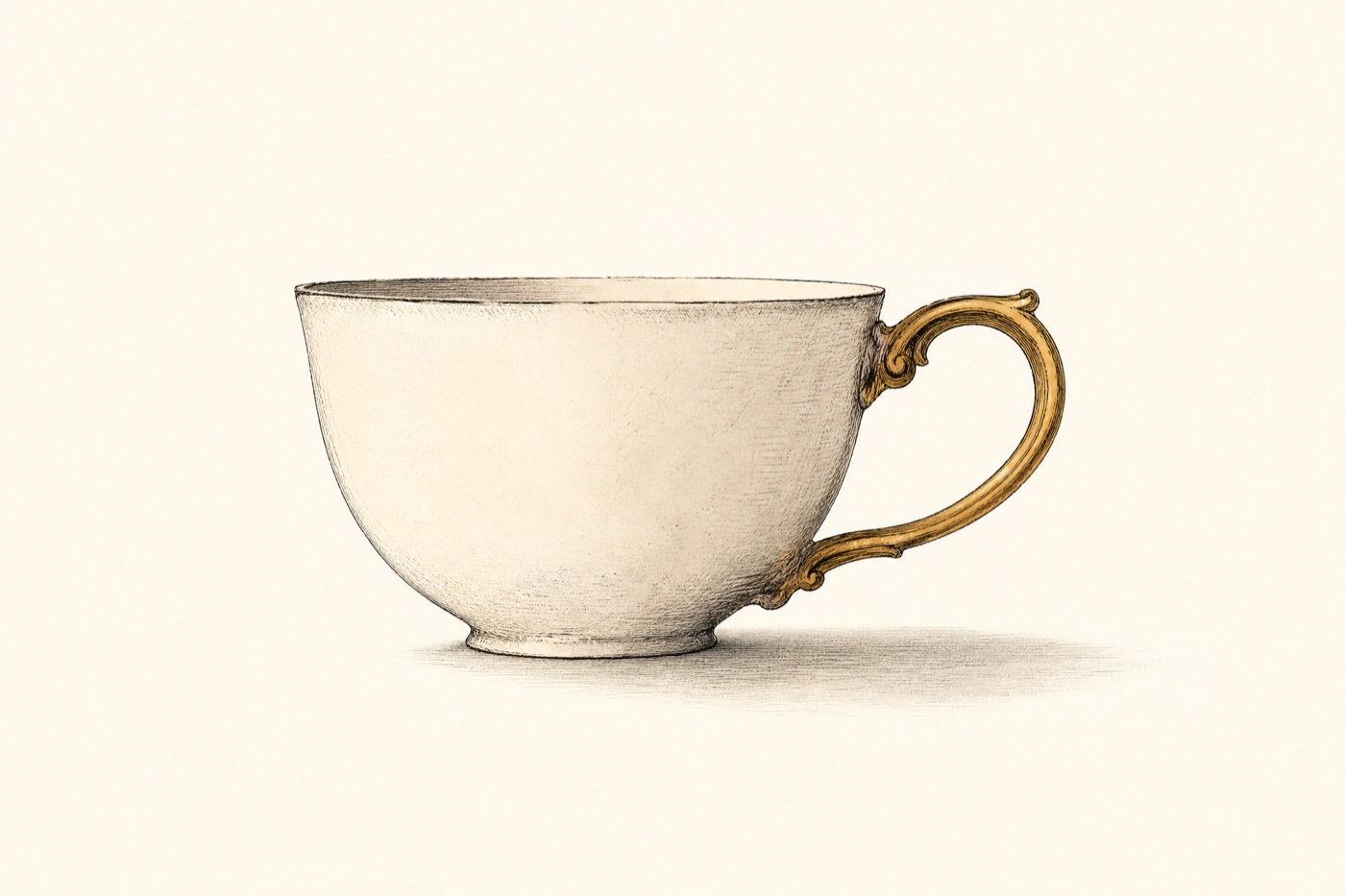
6. Full normality is a symptom; and the best part of a cup is the handle, because you do not drink from it.
(With thanks to my mother for this joke.)
A patient confides in his psychiatrist: I do everything as expected. I work eight
hours, sleep eight, rest eight. I have no depression, no trouble with the law. A
peaceful marriage, two children, a stable corporate position. I pay my taxes, I don't
drink, I don't smoke, I cross at the crossing. My wife told me to come, because I have
one strange habit: when I drink strong tea at five, I eat the porcelain cup. I leave
only the handle.
The psychiatrist is silent for a long time in astonishment, then says: “That really
is strange. After all, the handle is the best part.”
The whole list of “normality” is a cup drunk to the dregs. Eight/eight/eight, taxes, the crossing, the corporation: the patient swallowed the entire vessel of expectations and came to be cured of the one thing in him that was not planned. He mistakes the symptom for the cure: the illness is that perfect order, not the single crack. (The second joke already knew it: whoever does everything “properly” has just lost power over himself, only to expectations, not to chaos.)
The wife locates the symptom in eating the cup; the psychiatrist moves it to the handle; and the terrain, the whole drunk life, no one looks at (see 5). The quarrel over where the illness lies is fought on the map, above an untouched terrain.
The punchline inverts who is mad here (see 4.2). The psychiatrist, the authority appointed to pronounce on sanity, eats cups himself and even knows the handle is best. The judge sits in the same asylum as the judged; the only thing that astonishes him is the remnant of sense in the patient: that he did not swallow something after all.
Because the handle is the part you do not drink from: it serves nothing but holding. Pure form, useless grace, the last piece of the cup not for sale. In a life that has digested everything functional, the best thing is precisely what could not be consumed.
And here the whole Tractatus Ludens turns out to be a handle. A joke is the part of existence you do not drink from: you settle nothing with it, you consume nothing, and yet it is by it that the whole hot mug of life is held, without scalding your hands. Philosophy swallows the cup down to silence (7). The joke leaves the handle. Hold this book by it.
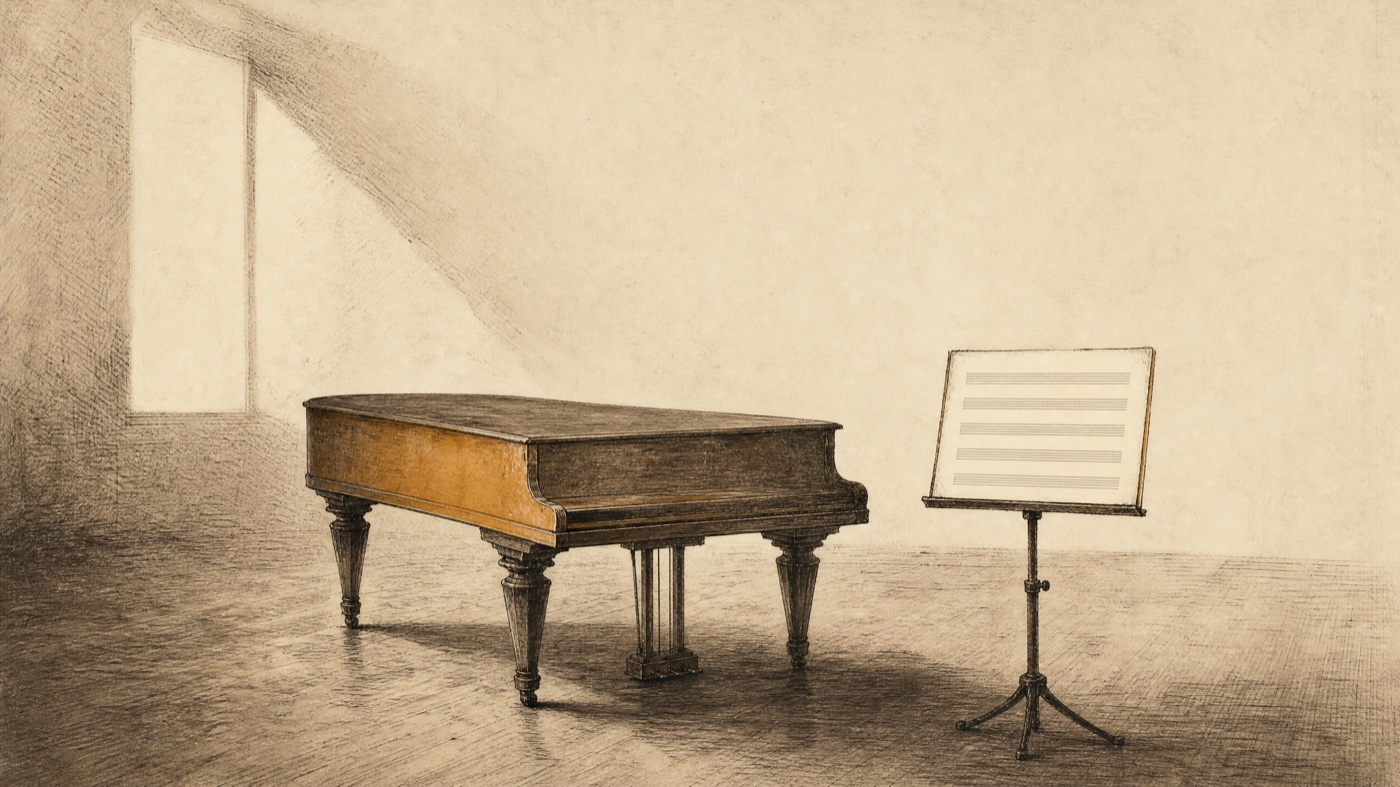
7. Whoever still plays all the notes is still searching. Whoever has found falls silent.
(Whereof one cannot play, thereof one must be silent.)
(With thanks to Orit for this joke.)
Two rival families: the parents of Danny and the parents of Alexander. Danny comes
to visit and sees a piano in the house. Coaxed, he sits down and plays a beautiful
“Für Elise”, and everyone applauds. Then Alexander's parents, whose son has been
practising for five years, insist that he too show what he can do. Alexander sits down
and plays a single note, C, the tonic, from the middle of the keyboard, in the
simplest possible way, with long pauses, for four minutes and thirty-three seconds.
The audience grows more and more bewildered. The embarrassed guests leave. The parents
ask what that was about. Alexander answers: “Danny is still searching. And I have
already found.”
Danny plays a multitude of notes: that is the sound of searching, the more notes, the longer the search. Alexander plays a single note, C, the tonic, the home note, and pauses. Whoever has found need not play out the rest. The answer is always shorter than the question.
Cage's 4′33″12 is not silence, but the handing of the floor to the world. “Everything we do is music,” said Cage: if everything we do is music, then the pause plays too. When the performer stops adding his own noise, you hear the room: coughs, the creak of a chair, the bewilderment of the guests. Alexander did not stop playing; he stopped drowning out. To find is to fall silent enough to hear that the rest is already sounding.
That is why the guests leave embarrassed (see 4.2, 6.3): the salon rewards searching with applause, and finding with emptiness. In a contest of display, the winner is whoever refuses to display, because he changes the rule of what playing is (3, 5). Truth empties the room. Alexander is left alone, like that madman from the fourth joke who would not step on the beam and stayed on his roof; but it is the same empty roof seen from the other side: the one was left alone because he did not trust, this one because he found. On both sides of the gap one stands equally alone.
And here, on the seventh sentence, Ludens catches up with Theta. Wittgenstein ends: “Whereof one cannot speak, thereof one must be silent” (7), and falls silent. Alexander falls silent too. The whole difference the Preface promised, Theta in silence, Ludens in laughter, turns out to be one thing: 4′33″ is silence that is a joke, and a joke that is silence. The most serious philosophical work and the simplest joke meet in a single pause. This is the entire proof of the sentence on the title page.
Danny is still searching; Alexander has already found. And you hold the book by its handle (6.5) and have just reached the note after which there are no more notes. The rest sounds on its own.
Dedication
For my son Alexander, known for his wit, who has just turned sixteen. (I am a little late; in a father's notation, that is still
on time.)
Sixteen shows on one hand as a single finger: thumbs up. Because the thumb is the
highest bit (2⁴): raised alone it means 10000₂, that is, 16. And thumbs up
also means: well done, it worked, I like it. The same sign, two symbols, both true
(see Joke three).
You are the best proof of sentence 3: that the same sign, read through love, always
means more than it shows. That is why this thumb is at once the number of your years and
the whole review.
And all in all, this whole treatise is written for you, because I know you will
understand.
Dad
Notes
Norman Malcolm, Ludwig Wittgenstein: A Memoir (1958). The source of the quoted remark that a serious philosophical work could be written consisting entirely of jokes. ↩
Ludwig Wittgenstein, Tractatus Logico-Philosophicus (1921). The source of the decimal numbering and the closing in silence (proposition 7). ↩
No Man's Land, dir. Danis Tanović, 2001. The optimist-and-pessimist exchange. ↩
Stanisław Lem, Filozofia przypadku. Literatura w świetle empirii (The Philosophy of Chance, 1968). Lem's conception of the work as an interpretive process and a chance co-authoring of meaning is one of the hidden contexts of this text. ↩
That power always works both ways, that whoever steers is also steered, was shown by Prof. Marian Mazur in the Polish school of cybernetics. See Cybernetyka i charakter (Cybernetics and Character, 1976). ↩
The maxim scientia potestas est ('knowledge is power') comes from Francis Bacon, Meditationes Sacrae (1597). ↩
Alan Moore and Brian Bolland, Batman: The Killing Joke (DC Comics, 1988). The joke of the two lunatics and the beam of light. ↩
Ludwig Wittgenstein, On Certainty (Über Gewißheit, publ. 1969). The hinge propositions one must stand on. ↩
Alfred Korzybski, Science and Sanity (1933). “The map is not the territory.” ↩
The aphorism ‘all models are wrong, but some are useful’ comes from the statistician George Box (1976). ↩
John Cage, 4′33″ (1952). A piece in three movements in which the performer plays not a single note. A recording. ↩
We use Google Analytics cookies to see which jokes you read. Accept or decline, as you prefer.